E-Commerce Product Page SEO Tips And Discount Strategies
Succeeding in e-commerce requires balancing two distinct disciplines: driving traffic to your store, and converting that traffic into paying customers once they arrive. High search rankings won’t save a site with a poor user experience, and an incredible discount strategy is useless if nobody sees it.
To maximize your revenue, your product pages must satisfy search engine crawlers while simultaneously lowering purchasing friction for human shoppers.
Part 1: The E-Commerce SEO Checklist & Strategy Guide
Search engine optimization (SEO) for retail sites relies on structural clarity and direct relevance. By executing a clean framework, you ensure search engines can crawl, index, and properly rank your store.
The 4 Pillars of SEO
Every optimization effort falls into one of four core categories:
- Technical SEO: Crawlability, site architecture, and indexation status.
- On-Page SEO: Content optimization, keyword placement, and HTML tags.
- Off-Page SEO: Brand authority, backlinks, and digital PR.
- User Experience (UX): Core Web Vitals, mobile responsiveness, and clean layout design.
Part 2: On-Page Optimization Secrets
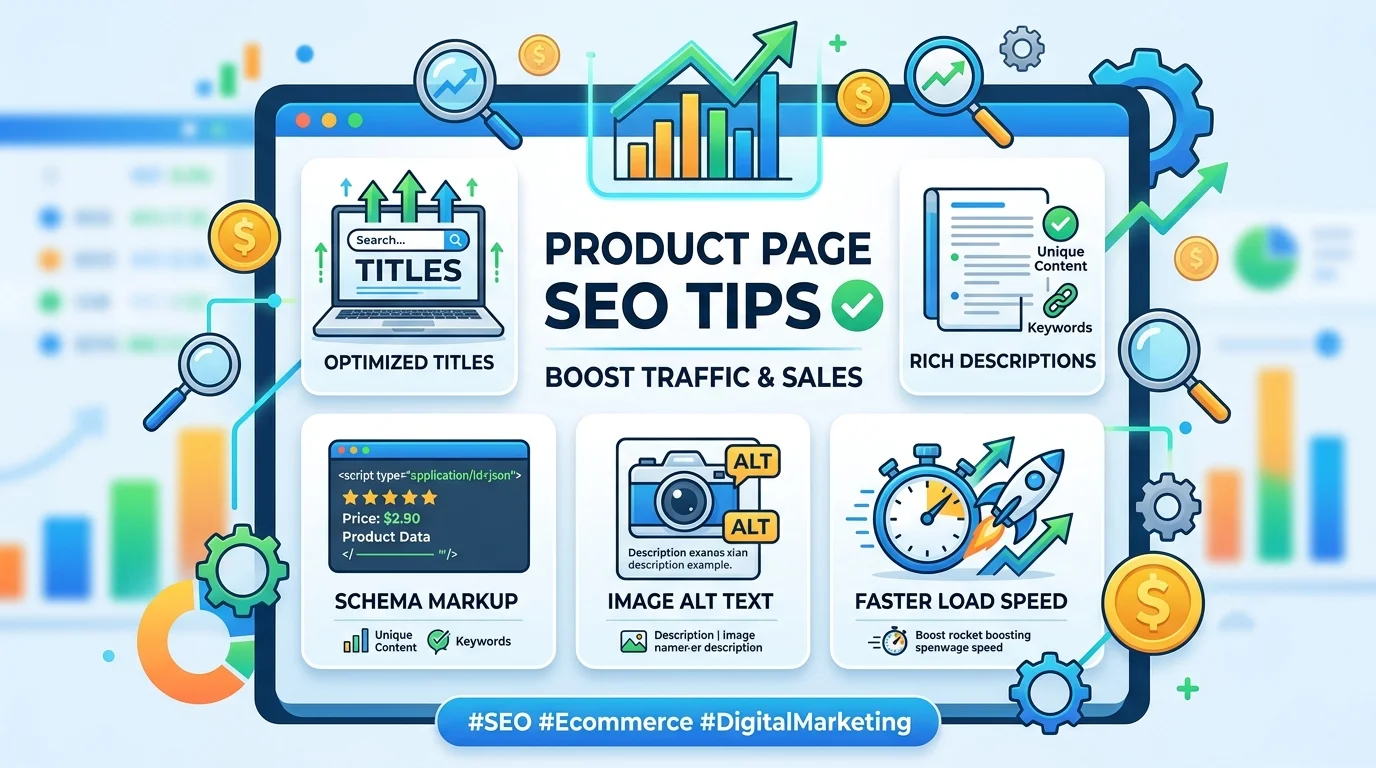
Write Relevant Product Titles
Product titles serve as your organic headline in search results. Avoid creative or vague names that confuse search algorithms.
- The Formula: Brand + Model + Key Feature/Material + Color + Size
- Example: Patagonia Men’s Torrentshell 3L Waterproof Jacket – Black, Medium
- Why it works: This structure matches natural search intent and addresses long-tail keywords immediately.
Put Out Unique and Useful Content
Duplicate content is an absolute traffic killer for e-commerce sites. Copying manufacturer descriptions verbatim guarantees your page will be buried under dozens of competitors using the exact same text.
- Unique Descriptions: Write custom, benefits-driven copy for every item. Focus on how the product solves a specific problem.
- Format for Scannability: Use brief paragraphs and bulleted feature lists so buyers can evaluate the item in under three seconds.
- Incorporate E-E-A-T: Showcase Experience and Expertise by explaining the design process, materials testing, or hosting an expert review video directly on the page.
Include Keywords in URLs
Keep your folder structures logical, flat, and human-readable. Eliminate random tracking strings, numbers, or automated parameters from your main URL paths.
- Bad URL: [example.com/prod_id=98723?ref=shoptop](https://example.com/prod_id=98723?ref=shoptop)
- Good URL: [example.com/mens-footwear/leather-running-shoes](https://example.com/mens-footwear/leather-running-shoes)
E-Commerce Category Page SEO
Category pages often hold significantly higher ranking potential than individual product pages because they target broader, high-volume search terms.
- Add Intro Text: Include 100 to 150 words of highly optimized context at the top of the category page to assist crawlers.
- Internal Linking: Link directly to your top-performing items from the category view using keyword-rich anchor text.
- Implement Schema Markup: Use CollectionPage structured data to explicitly define the relationships between your products and categories.
Part 3: Technical & Mobile Performance Optimization
Improve Your Page’s Load Speeds
A slow site directly degrades your conversion rates. Google’s algorithms penalize pages that fail Core Web Vitals targets, such as Largest Contentful Paint (LCP).
[Compress Images] ➔ [Minimize CSS/JS] ➔ [Implement CDN] ➔ [Faster Load Times]
- Image Optimization: Convert bulky PNGs/JPGs to modern WebP or AVIF formats.
- Code Cleanliness: Minify CSS, JavaScript, and HTML while eliminating redundant tracking pixels.
- Leverage CDNs: Use a Content Delivery Network (like Cloudflare or Fastly) to serve site assets from servers physically closest to your visitors.
Optimise Your Site for Mobile
Mobile devices drive over 60% of global e-commerce traffic. A desktop-first approach to design is no longer viable.
- Sticky Add-to-Cart Buttons: Keep purchase buttons anchored to the top or bottom of the screen as users scroll.
- Simplify Forms: Streamline checkouts by minimizing input fields and enabling single-click digital wallets (Apple Pay, Google Pay).
- Thumb-Friendly Navigation: Ensure interactive elements and menus are easily tappable on small screens.
Part 4: High-Converting Discount & Retention Strategies
Attracting traffic is only half the battle; high-impact promotional strategies convert that traffic into actual revenue.
Offer Free Shipping
High shipping charges are the leading cause of abandoned shopping carts.
- The Threshold Strategy: Offer free shipping on orders above a set target (e.g., Free shipping on orders over $75). This routinely boosts Average Order Value (AOV).
- Incorporate Costs: Build baseline shipping costs directly into your product pricing model to protect your margins while offering a friction-free checkout.
Offer Bundled Deals
Grouping complementary items together helps clear slow-moving inventory while increasing order totals.
- The Cross-Sell Method: Pair a primary item with essential accessories (e.g., selling a digital camera along with a memory card and a tripod at a combined 15% discount).
- Frequently Bought Together: Use automated, on-page layout elements to show shoppers the exact items others typically pair with their selection.
Use Coupon Codes
Vouchers provide a powerful incentive for immediate conversions when implemented strategically.
- Exit-Intent Offers: Trigger a pop-up code offering a small discount right as a user’s mouse moves to close the browser tab.
- Welcome Incentives: Offer a fixed discount (like 10% off) in exchange for an email newsletter signup, turning anonymous traffic into identifiable leads.
Recapture Lost Customers
Automated retargeting brings window shoppers back to your store to finalize their orders.
- Abandoned Cart Email Sequences: Automatically send a friendly reminder email 1 hour, 24 hours, and 48 hours after a cart is left behind.
- Dynamic Retargeting Ads: Use Meta or Google tags to display the exact items a user was just viewing across social media platforms.
Part 5: Competitive Intelligence with Ahrefs E-Commerce
Using professional SEO tools like Ahrefs removes the guesswork from your optimization strategy.
- Keyword Gap Analysis: Input your main competitors’ domains to see the specific high-volume phrases they rank for that your site completely misses.
- Backlink Intersect: Identify domains that link to multiple competitors but don’t link to you yet. These are your prime link-building outreach targets.
- Click-Through Rate (CTR) Tuning: Analyze positions where your site ranks well but suffers low traffic. Rewrite your meta descriptions and title tags to win more clicks.
Conclusion
E-commerce growth relies on optimization across multiple disciplines. By combining strong technical SEO foundations with highly compelling conversion incentives, you build an online storefront that ranks effectively and converts visitors into loyal customers. Review your data regularly, optimize your site speed, and keep your content unique to stay ahead of the competition.