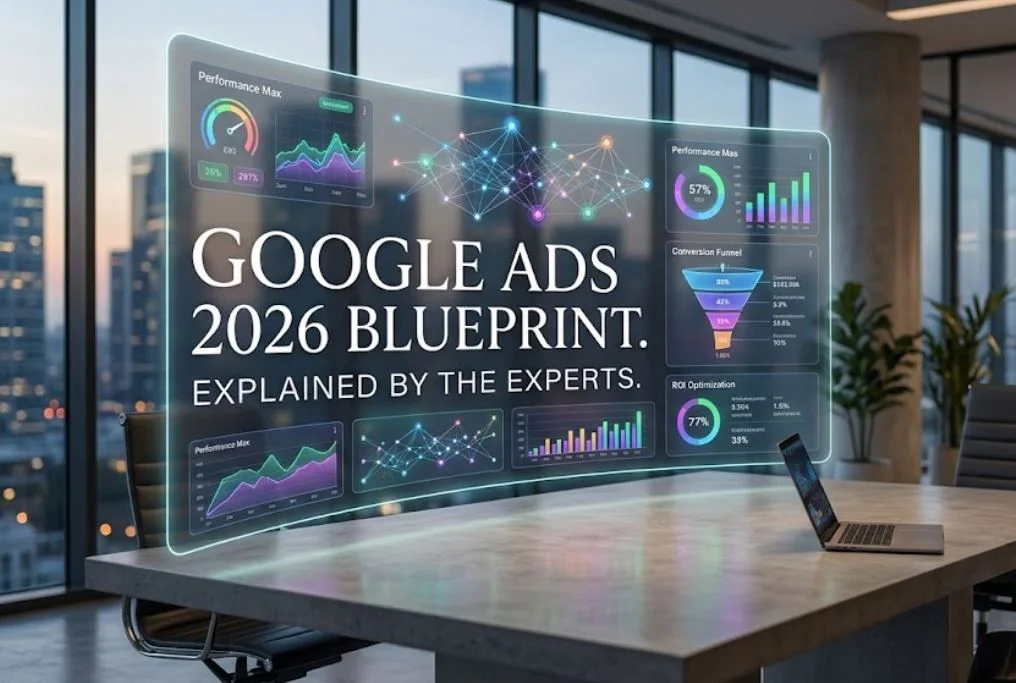
Google Ads Explained by the Experts: The Complete 2026 Blueprint
If you feel like Google Ads has completely changed over the last few years, you are not imagining things. In fact, 2026 has brought the biggest paradigm shift the platform has ever seen. The days of manually managing endless keyword match types and tiny bid micro-adjustments are effectively over.
Today, Google Ads is an AI-first machine. This doesn’t mean you are obsolete as a marketer; it just means your job description has changed. You are no longer a technical operator—you are a strategic director.
Following Google Ads’ 2026 policies is critical because compliance directly dictates your ability to run ads and protect your brand. This year, Google introduced strict structural changes centered on AI data control and transparency.
First, missing compliance means a total revenue blackout. Under the 2026 AI Transparency update, any creative built or edited with third-party tools must be manually disclosed. Failing to flag synthetic content leads to immediate ad disapproval and account restriction.
Additionally, Google’s updated Limited Ad Serving Policy automatically throttles impressions for unverified advertisers or those using generic, unbranded ad copy. If your data tracking lacks perfect alignment with Advanced Consent Mode, Google cuts off your access to behavioral data entirely. Without this data, your Performance Max and AI Search campaigns cannot optimize, destroying your ROAS (Return on Ad Spend).
Ultimately, staying compliant protects your budget from being restricted by machine-learning safety nets. Adhering to the 2026 policies ensures your ads remain visible in a strictly regulated, AI-driven marketplace.
The Expert Strategic Quotes
These focus on what makes a paid campaign actually convert:
“Always be relevant, create relevant campaigns, and give the user the answer to his query as precisely as you can.”
— Marko Kvesic, GoTraffic
“On the average, five times as many people read the headline as read the body copy. When you have written your headline, you have spent eighty cents out of your dollar.”
— David Ogilvy
“Instead of one-way interruption, Web marketing is about delivering useful content at just the right moment that a buyer needs it.”
— David Meerman Scott
1. The Core Shift: From Manual Control to AI Input Management
The underlying philosophy of Google Ads has evolved. Instead of telling Google exactly how to place your ads, you provide the system with a budget, a business goal, and a rich library of creative assets. Google’s AI then dynamically pieces them together to find the right customer across Search, YouTube, Discover, Maps, and AI Overview placements.
The Expert Rule of 2026: Your AI is only as smart as the data you feed it. If you give it weak creative assets or messy conversion data, it will optimize for the wrong results.
2. Navigating the 2026 Campaign Ecosystem
To win this year, experts rely on a “Power Pack” strategy combining three core campaign types:
| Campaign Type | What It Does | Best Used For |
| Performance Max (PMax) | Automates ad delivery across all of Google’s properties from a single asset pool. | Maximizing conversions and finding unexpected pockets of buyers. |
| Demand Gen | Uses visually driven formats on YouTube (Shorts), Discover, and Gmail. | Mid-to-top of funnel awareness and visually showcasing physical products. |
| AI Max for Search | The modern evolution of traditional search campaigns, leaning heavily on URL expansion and broad match automation. | Capturing high-intent users navigating conversational search paths. |
3. The New Rules of Google Ads Ad Copy
With search evolving into conversational exploration (like Google’s “AI Mode”), your text needs to match how people actually talk, not just repeat robotic keywords.
-
Prioritize Continuity: The Google algorithm deeply rewards relevance. Ensure a flawless semantic thread from the user’s conversational query to your ad copy, straight down to your landing page.
-
Leverage Psychology & Incentives: Stand out from automated noise by injecting genuine social proof, tangible incentives (like exclusive offers), and benefit-driven phrasing into your 15 headlines and 4 descriptions.
-
Disclose Synthetic Content: If you use Google’s built-in AI tools to generate images or text, pay close attention to the 2026 AI Transparency features. Correctly labeling or attesting synthetic content keeps you compliant with regional laws like the EU AI Act.
4. The 2026 Implementation Roadmap
If you are launching or rebuilding a Google Ads account today, experts recommend a phased roll-out to give the machine learning algorithms proper time to calibrate:
Summary Takeaway
The experts aren’t fighting the automation; they are feeding it. Your edge in 2026 rests on your ability to offer deeper first-party audience signals, clean conversion data, and stunning, human-crafted creative assets that an AI simply cannot replicate.