
How Apple’s Privacy Policies Are Changing Digital Advertising in 2026
Apple’s ongoing privacy updates, particularly App Tracking Transparency and SKAdNetwork enhancements, have redefined user data collection. To succeed in 2026, advertisers must align with updated privacy standards and Google’s latest Ads guidelines. Emphasizing first-party data collection, consent-based tracking, and privacy-preserving APIs ensures compliant, sustainable campaign performance without relying on intrusive user tracking techniques.
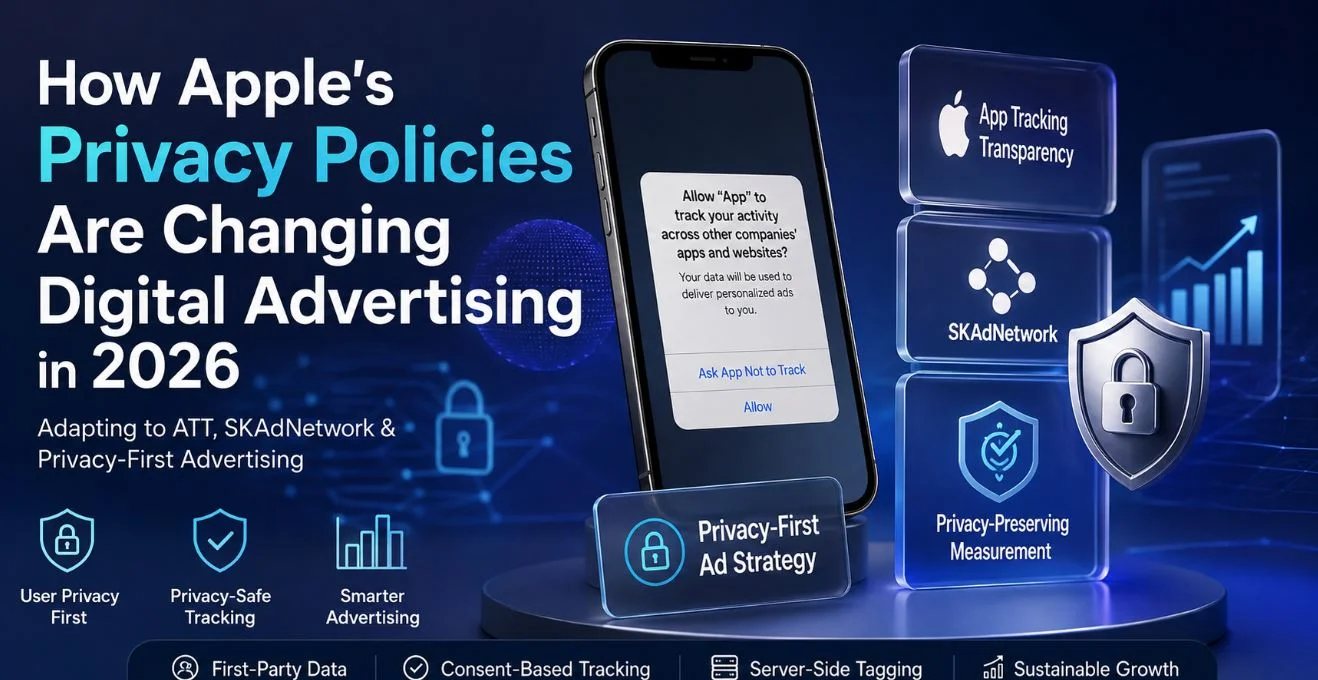
The Evolution of Tracking: Why Apple’s Privacy Changes Hit Advertisers So Hard
The digital advertising ecosystem experienced a seismic shift when Apple introduced strict App Tracking Transparency (ATT) policies. By requiring explicit user opt-in before tracking activity across third-party apps and websites, opt-in rates dropped significantly, stripping advertisers of key user identification data. Traditional ad attribution models, which relied heavily on granular user-level profiles, became unreliable overnight.
As a result, major ad platforms saw reduced targeting accuracy and higher costs per acquisition (CPA). Small businesses and performance marketers who depended on retargeting audiences felt the biggest impact, as custom audiences shrunk dramatically. To adapt, ad platforms shifted toward aggregated data reporting and machine learning to estimate conversions. However, relying on estimated performance requires a fundamental change in media strategy.
Advertisers must now move away from heavy reliance on third-party cookies and hyper-specific behavioral targeting. Instead, modern strategy focuses on capturing zero-party and first-party data directly through meaningful user interactions. Building direct relationships with your audience ensures long-term ad stability, even as privacy restrictions continue to tighten across mobile operating systems.
What Search Platforms Say About Modern Privacy Compliance
“Privacy and performance do not have to be a trade-off; privacy-preserving measurement tools ensure businesses grow while respecting user choices.”
Core Strategies for Advertisers Navigating iOS Privacy Restrictions
To maintain strong return on ad spend (ROAS) under Apple’s ecosystem constraints, digital marketers must rebuild their tracking and optimization frameworks around privacy-first architecture.
1. Harness First-Party and Zero-Party Data
Instead of relying on external tracking pixels:
-
Collect customer data directly via interactive content, surveys, and sign-up forms.
-
Implement Server-Side Tagging to capture events securely on your own domain.
-
Integrate Customer Relationship Management (CRM) tools directly with your advertising networks.
2. Implement Privacy-Preserving API Frameworks
Modern ad networks offer privacy-compliant tracking alternatives that honor user consent choices:
-
Utilize conversion modeling to fill data gaps responsibly.
-
Set up Enhanced Conversions to pass hashed first-party data securely.
-
Adopt Apple’s SKAdNetwork (SKAN) and Privacy Sandbox frameworks for cross-app attribution.
3. Diversify Channel Strategy and Creative Testing
When pinpoint audience targeting is limited, high-performing visual creative and platform diversity carry the load:
-
Broaden targeting parameters and rely on platform AI for dynamic delivery.
-
Test multiple ad variations to identify what resonates naturally with broader audiences.
-
Work alongside experienced specialists who understand multi-channel campaign architecture, such as the growth teams at Digital You, to audit and update your tracking setups.
Rethinking Success Metrics and Campaign Performance
Measuring campaign effectiveness no longer means tracking individual user journeys step by step. Instead, modern media buyers evaluate holistic performance using broader business metrics, such as Media Efficiency Ratio (MER) and overall blended ROAS. By looking at revenue growth relative to total ad spend across all channels, brands avoid getting misled by incomplete in-platform attribution reporting.
Adopting modeled conversions allows brands to maintain clear visibility without violating user privacy preferences. Combining deterministic data (direct user consent) with probabilistic insights gives marketers a clear, actionable view of performance trends.
If you have questions about adjusting your measurement stack or want to discuss your privacy strategy, feel free to reach out through our Contact Page. Exploring tailored solutions across our full range of Digital Services can help keep your business ahead of industry shifts.
Final Thoughts
Apple’s privacy updates reflect a permanent shift toward a privacy-first web ecosystem. Success in 2026 demands that advertisers embrace first-party data strategies, privacy-preserving measurement, and high-quality content. By aligning campaign infrastructure with modern compliance guidelines, brands can continue driving measurable growth while fully respecting user privacy choices.